
October is Careers in Construction Month, which makes it a good time to reflect on a simple yet important question: Who’s going to build what’s next?
According to the National Center for Construction Education and Research (NCCER), 41% of all construction and manufacturing professionals will retire by 2031, leaving significant workforce gaps. Meanwhile, demand for construction jobs will continue to grow. According to the Bureau of Labor Statistics (BLS), construction jobs are expected to increase faster than the average growth rate for all other occupations from 2025 to 2035.
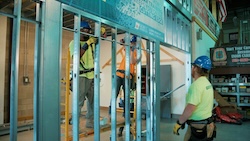
Fewer hands is one problem, but losing the knowledge in those hands is a bigger one. Things like proper lath embedment, drift connector installation, and consistent drywall finish levels are mostly learned on the jobsite and can take years to master. Training the next generation protects the quality of the work and the reputation behind it.
Attract: Change the Narrative
Part of the challenge is cultural. Since the GI Bill of 1944, a “college-for-all” narrative has steered students toward four-year degrees over vocational paths, despite the fact that trade school is often less expensive and allows people to start earning at a younger age. (Not to mention, the BLS reports that the median annual wage for construction jobs is about 17% higher than the median annual wage for all occupations.)
Attracting the next generation of skilled workers starts with changing the narrative. In fact, careers in the trades are ever more reliable. As a Forbes article put it: “AI can do a lot, but it will probably never be able to fix or replace clogged plumbing in a home, diagnose and repair HVAC issues, or troubleshoot electrical issues in a homeowner’s attic.”
If changing the conversation is the first step, putting tools in students’ hands is the second. Manufacturers and contractors alike can increase exposure of the trades. Visit schools, host jobsite tours, and join career days. Support skills competitions like SkillsUSA and partner with local programs or apprenticeships that give students hands-on experience building something. The more opportunities students have to see the work and hear about the growth paths within a career in the trades, the less likely they’ll be to rule it out.
Train: Make Knowledge-Transfer Deliberate
The first few months of a job are crucial for retention. A worker who feels capable takes pride in what they build, whereas a worker who feels lost starts looking for the exit. Investing in how new hires learn is one of the most direct ways to improve both the quality of the work and the odds they’ll still be in the trade for years to come.
The goal is getting a new hire productive and confident as fast as possible. A dedicated mentor goes a long way in helping with this. Equip mentors with a skills checklist to ensure necessary knowledge is transferred and mastered. Installation guides, how-to videos, and manufacturer technical support can reinforce what new hires learn in the field, and encouraging apprenticeships and certifications can give new workers a recognized benchmark.
In addition to the physical skills, it’s important for mentors to teach the “why.” Someone who understands why things are done a certain way—why lath must be embedded, why a connector allows certain levels of movement, or why one corner bead type might be used over another in certain applications—will be more likely to catch mistakes and take pride in the quality of their work.
Retain: Give People a Reason to Stay
Recruiting only works if people stick around. In order to permanently resolve the skilled labor gap, younger workers must be able to see the trades as a viable long-term career. Feeling appreciated and seeing room for growth go a long way here. From an employer’s standpoint, investing in the basics—quality tools, safe sites, predictable schedules—shows respect for the person doing the work. Tying advancement opportunities to skills and qualities and promoting from within shows crews that they can grow in their career here—and gives them something to strive for.
Start Where You Are
Careers in Construction Month doesn’t mean the skilled labor gap will be solved in a month, but it’s a great time to start addressing the issue. Invite a student to your jobsite, name a mentor for your newest hire, or sponsor a local competition. Every small action today helps to build the workforce of tomorrow.